
Research · Semiconductor Manufacturing
Elon Musk calls it the largest and most valuable building on Earth. SpaceX's own IPO paperwork calls it a "general framework" with no binding commitments. Both of those things are true at once, and the gap between them is basically the whole story. Here's what the numbers actually say, phase by phase.

Somewhere between "the largest and most valuable building on Earth" and "a general framework with no binding commitments," there's an actual chip factory getting built in rural Texas, and it's worth figuring out which parts of the Terafab story are concrete and which parts are still, quite literally, a rendering. We went through the county filings, the earnings calls, the property tax abatements, and Musk's own numbers to separate what's confirmed from what's aspiration. Both categories turn out to be interesting.
The basics: what Terafab actually is
Terafab is a joint venture between Tesla, SpaceX, and Intel, aimed at building a vertically integrated semiconductor complex — meaning logic chips, memory, advanced packaging, and testing would all happen under one roof, rather than being split across specialist suppliers the way the industry normally works. Tesla and SpaceX bring the capital and the demand; Intel brings the process technology, specifically its 14A node, and the manufacturing expertise neither carmaker nor rocket company has in-house.
The project actually spans two sites, which gets lost in most of the headline coverage. A small prototype "Research Fab" broke ground in April 2026 at Tesla's Giga Texas North Campus in Austin — built for rapid iteration, where engineers can design a chip, fabricate it, test it, and revise it without shipping wafers between facilities. The full-scale production complex, the one carrying the eye-watering dollar figures, is a separate site roughly 90 miles away in Grimes County.
Quick facts
The money: three numbers, one confusing story
Follow the dollar figure through 2026 and it moves around more than you'd expect for a single project. When Musk first announced Terafab in March, the number attached was $25 billion. By May, a Grimes County property tax filing put the first phase alone at $55 billion, with the full multi-phase buildout reaching as high as $119 billion. Then in August, when Governor Abbott and Musk actually confirmed the Grimes County site, the number that got announced was $16.8 billion — less than a third of the $55 billion figure SpaceX's own filing had put on the record three months earlier.
Nobody involved has fully explained that gap publicly. The most reasonable read is that $16.8 billion represents a narrower, more immediate slice of construction, while $55 billion and $119 billion describe a fuller buildout that depends on Terafab actually working and scaling as planned. Worth sitting with that distinction, because it recurs throughout this story: there's a confirmed number and there's an aspirational number, and press coverage doesn't always make clear which one it's citing.
Four numbers, four different moments — the confirmed figure is the smallest one, and the largest one is still a projection.
There's a legal wrinkle underneath all of this worth flagging plainly: SpaceX's own S-1 filing for its roughly $1.75 trillion IPO, filed in May, described Terafab as only a "general framework," with no binding commitments, no finalized intellectual-property split between the partners, and no obligation for either side to keep participating. That's SpaceX's lawyers being precise in a securities filing while its executives are simultaneously giving press conferences about the largest building on Earth. Both statements can be true. It just means the eventual scale of Terafab depends on a lot of decisions that haven't been locked in yet.

The technology: Intel 14A and full vertical integration
Musk announced in April that Terafab's full-scale production would run on Intel's 14A process — Intel's next-generation node, in the neighborhood of 1.4 nanometers, still under development at the time of the announcement. Musk's own framing was notably hedged: he said that by the time Terafab actually scales up, 14A "will probably be fairly mature or ready for prime time," which is a reasonable way of saying the technology it depends on isn't fully proven yet.
The wafer-volume ambition is genuinely large by industry standards. The Research Fab in Austin operates at an experimental scale of a few thousand wafer starts per month. The Grimes County production complex is described as targeting 100,000 wafer starts per month at prototype production scale, scaling toward 1,000,000 wafer starts per month at full capacity — a number that, if realized, would put Terafab in the same conversation as the world's largest existing fabs, run by companies with decades more manufacturing experience.
On the hiring side, Tesla brought in Gary Jiang, a 17-year Intel manufacturing veteran who ran Intel's own 18A factory ramp in Arizona, to serve as Terafab's director — a clear signal that Tesla knows it needs institutional semiconductor expertise it doesn't currently have, and is buying that expertise rather than assuming automotive and aerospace manufacturing experience will transfer directly.
The footprint: how big is 100 million square feet, actually
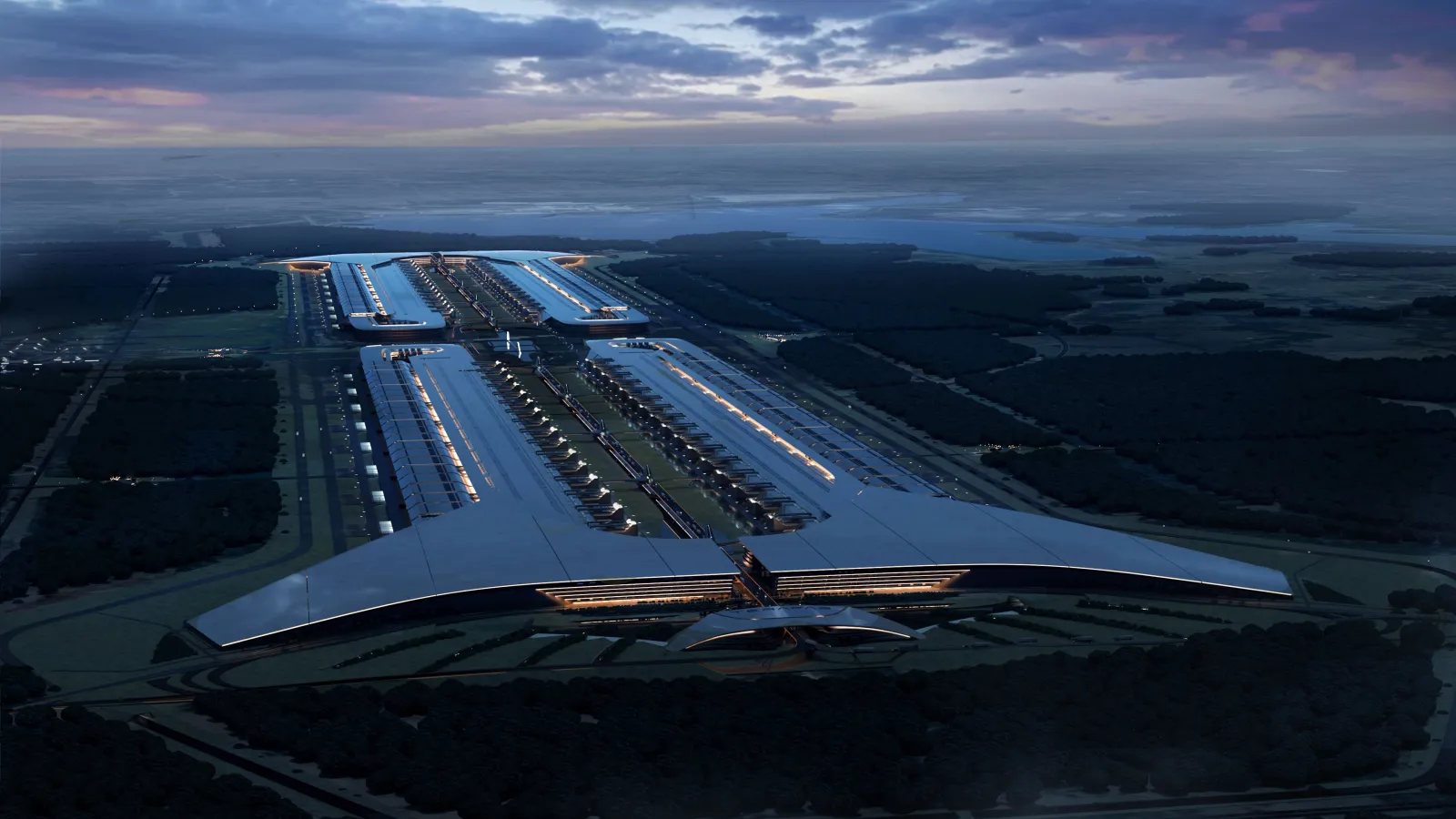
The headline size claim is that Terafab, at full build-out, will exceed 100 million square feet of manufacturing space under one roof. Numbers that large stop meaning much without something to measure them against, so here's the comparison set several outlets have put together independently.
At its stated maximum, Terafab would out-measure the current record holder by more than five times — and it would take Pentagon, Mall of America, and Apple Park combined and still have room left over.
Musk's own description leans further than that comparison chart does — he's been quoted describing Terafab as roughly 50 times the size of the Pentagon, a comparison that doesn't quite reconcile with the raw square-footage figures both buildings have publicly reported, which put the multiple closer to 15 times. Whether that's a different measurement basis (volume rather than floor area, for instance) or simply Musk rounding up for effect isn't clear from public statements. Either way, on the more conservative floor-area math alone, Terafab would still be the largest building humans have built.
The location: why Grimes County, and why the water sourcing matters
The production complex sits on the site of the former Gibbons Creek Steam Electric Station, a coal-fired power plant that shut down in 2018, roughly 9.5 miles southeast of Anderson, Texas. It's about 20 miles east of Bryan–College Station, 70 miles northwest of Houston, and 90 miles northeast of the Austin research site — close enough to Texas A&M for an obvious talent pipeline, far enough from any major metro to have drawn a genuinely surprised local reaction when the announcement landed.
The choice of a former power-plant site isn't incidental. It comes with existing grid connections, transmission capacity, and water infrastructure already built out from decades of running a coal plant — a meaningfully lower-friction starting point than building comparable infrastructure from scratch. SpaceX has specifically committed to drawing process water from the Gibbons Creek Reservoir itself, rather than from local groundwater, and has said on-site wastewater treatment and recycling systems are part of the design. That's a direct response to a concern that's become politically loud across Texas as data centers and industrial facilities have multiplied: large, thirsty industrial users competing with residents for a limited groundwater supply.

The output target: 1 terawatt, and what that number is actually measuring
SpaceX and Tesla's stated goal is for Terafab to produce more than 1 terawatt of AI compute capacity annually once fully ramped — a figure both companies describe as exceeding total current global compute supply. That's a claim worth treating carefully: it's a projection about a facility that hasn't finished being built, based on a process node that isn't fully mature, competing against a global chip industry that isn't standing still in the meantime.
Musk has given one partial breakdown of where that compute would actually go, posting that his rough estimate is around 25% of Terafab's output would go toward Tesla's Optimus humanoid robot program specifically. He hasn't published a full breakdown covering the remaining share across SpaceX's own compute needs, Tesla's vehicle and AI programs, and xAI. Separately, some industry trackers following the project have described the broader ambition as roughly 100 to 200 gigawatts of terrestrial compute capacity plus the 1-terawatt figure specifically earmarked for space-based compute — though that framing comes from third-party analysis rather than a direct company statement, and is worth treating as an informed estimate rather than a confirmed target.
The controversy: 900 signatures and a list of 12 demands
The financial and technical numbers tell one side of this story. The other side played out in a Grimes County commissioners' meeting room. The night before the official August announcement, hundreds of residents showed up to express concern over the scale of tax incentives being discussed and what they described as a lack of transparency in how the deal had come together. Nearly 900 residents signed a petition on August 5 asking for 12 specific protections before the county extended any further support: independent legal counsel paid for by the county rather than by SpaceX, explicit water and environmental safeguards, requirements to repair roads damaged by construction traffic, funding for expanded emergency services, and clawback provisions that would kick in if SpaceX failed to deliver on its investment and employment commitments.
SpaceX's response was to show up. Representatives met face-to-face with Grimes County residents for the first time on August 5 and 6, confirming that the core agreements were signed and active, and directly addressing the water-sourcing question. A county judge separately proposed a formal accountability resolution. Whether that satisfies the full list of resident demands is, as of this writing, still an open question — worth watching as the project moves from paperwork into actual construction.
Where things actually stand
As of this article's publish date, the clearest way to describe Terafab's status is: confirmed on paper, partially underway on the ground, and mostly still ahead of it. The Research Fab in Austin has visible foundation work progressing since its April groundbreaking. The Grimes County production complex has a signed JETI tax abatement agreement, a $10 million non-refundable payment made as part of that agreement, a confirmed site, and — depending on which outlet you read — either early site preparation or the beginnings of actual groundbreaking; reporting on that specific point has not been fully consistent, which is itself a reasonable signal that heavy construction is still in its early days rather than in full swing.
| Category | What's confirmed | What's still projection |
|---|---|---|
| Investment | $16.8B first phase, publicly announced Aug 2026 | $119B total, contingent on all phases proceeding |
| Site | Grimes County location confirmed, tax abatement signed | Full 100M sq ft build-out not yet constructed |
| Process technology | Intel 14A selected as the process node | 14A itself still maturing toward production readiness |
| Output | Research Fab operating at experimental scale in Austin | 1TW annual compute target, 1M wafer starts/month at scale |
| Corporate commitment | JV publicly announced by Tesla, SpaceX, Intel, and Texas's governor | SpaceX's own S-1 calls it a non-binding "general framework" |
Frequently asked questions
Is Terafab actually the largest building in the world right now?
Not yet. At full build-out it's projected to exceed 100 million square feet, which would surpass the current record holder — Chengdu's New Century Global Center, at about 18.9 million square feet — by a wide margin. As of now, construction hasn't reached anywhere near that scale.
Why did the confirmed investment figure drop from $55 billion to $16.8 billion?
Neither company has fully explained the gap publicly. The most plausible explanation is that $16.8 billion covers a narrower initial construction phase, while the $55 billion and $119 billion figures describe a fuller, more contingent buildout tied to the project actually scaling as planned.
Will Terafab solve Tesla's current chip supply problems?
Not in the near term. Tesla is currently dual-sourcing its AI5 chip from Samsung's Taylor, Texas facility and TSMC, with Samsung volume production not expected until the second half of 2027. Analysts have described Terafab as a multi-year, roughly decade-plus strategy to bypass the existing foundry hierarchy entirely, not a fix for today's constraints.
Has construction actually started at the Grimes County site?
Reporting is mixed. Some coverage describes early site preparation only; more recent reporting refers to groundbreaking having occurred. The Austin Research Fab's construction progress is more clearly documented than the Grimes County production complex's.
The bottom line
Strip away the superlatives and Terafab is a real, financially significant, technically ambitious project that is also, by its own primary backer's legal filings, not yet a binding commitment to build the thing as described. Both of those facts matter. The $16.8 billion that's actually been confirmed is a serious sum of money and 3,000 real jobs. The $119 billion, the 1 terawatt of compute, and the "largest building on Earth" framing are all still projections resting on a process node that isn't finished maturing and a construction timeline that's only just getting underway.
The honest way to read this data, taken together: Terafab is exactly as big as its confirmed numbers say it is right now, and it's only as big as its projected numbers say it will eventually be if every subsequent phase actually happens the way the pitch describes. Worth checking back in on those bigger numbers in a year.
Further reading on this topic
We'll revisit these figures as Terafab's construction progresses and as Intel's 14A process moves closer to production readiness. Check the Research section for follow-up coverage.
Financial figures, technical specifications, and construction status referenced in this article are drawn from public reporting, county filings, and company statements (TechRadar, The Motley Fool, Fortune, ABC News, Electrek, TechTimes, Tom's Hardware, and Grimes County public records) available as of the publish date. Several figures — particularly total investment potential, compute output targets, and construction status — represent projections or estimates rather than confirmed, audited figures, and may change materially as the project develops. Verify current figures directly with the companies or county records before citing them elsewhere. This article does not contain affiliate links; where future articles do, they will be disclosed per our Affiliate Disclosure.